
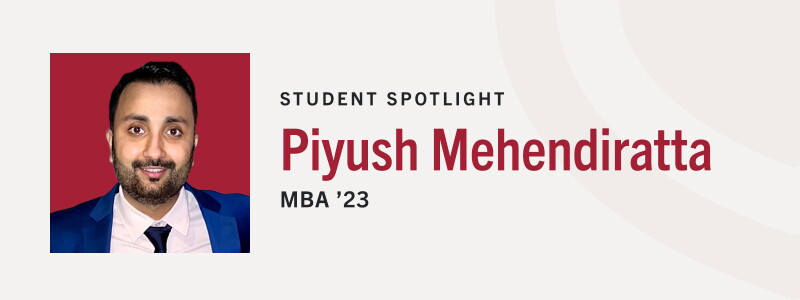
Piyush M., MBA '23, spends his days at Salesforce in the part of the company that most fascinates and unnerves the rest of the workforce. As a Solutions Architect, he designs scalable customer solutions built around the technologies reshaping every industry: AI, agentic AI, automation, and workflow.
So you might expect him to evangelize the tools. He doesn't.
"At the end of the day, a human is still needed to understand those problems and figure out what are the end-to-end goals for the client," he said. "The tools have changed. You can kind of get a script of a meeting through AI. But the work of nailing down those key business problems early—that hasn't changed."
That conviction is the through-line of his career. And the Santa Clara University Online MBA, he said, is what sharpened it.
From Business Analyst to Architect
Piyush started his career as a business analyst, then made a deliberate pivot in 2016 into a more technical role as a Solutions Architect. "In Silicon Valley, you need a technical background, too," he said. The new role required "not just the business mindset, but also how you work with developers, engineers on the back-end side."
After a few years, though, he hit a ceiling. Growth in pure technical roles felt capped, and a lot of the work was being outsourced. He needed a way to translate his hybrid background—part business strategy, part technical depth, part entrepreneur—into a story that opened doors instead of closing them.
He'd also been running a family business for over a decade in parallel with his day-job. The entrepreneurial muscle was already there. What he wanted was a sharper strategic frame.
"When I was looking at an MBA program, that Leading Innovative Organizations [concentration] made the most sense, having that hybrid kind of a mindset," he said. "It never allows you to be idle. You're always hustling between the two."
The Juggle
Piyush enrolled in Santa Clara's Online MBA program while running his family business, working full-time, and raising young children. During the program, he changed jobs (landing at Salesforce in 2022), and his second child was born. Today, his kids are three and five.
"People say, oh, they're busy," he laughed. "I had a business. I had a job. I switched jobs between that program. I had two kids, one was born during the program. There were a lot of challenges I was going through, and I still did very well in the program, and am still doing very well in the career."
His advice for anyone wondering whether they can fit a graduate program around an already-full life is unsentimental: Break it down by priority, list it out daily, and commit to consistency.
"It's easier said than done, because it requires the consistency, on a daily basis, to really make a change. Otherwise, these are just lists, and no action is taken. If I can do it, I think anyone can do it."
He gives the program a share of the credit for getting him through. Career services staff like Ray and Amy, he said, became "well-wishers"—people he shared his life with, who helped him find clarity when the path ahead was murky. The online format also surprised him in the best way. He'd initially wanted to be on campus but couldn't, given the kids. What he found instead was a structured, interactive program where students showed up prepared, contributed competitively, and built lasting relationships over Zoom. He predicts that his connections with several SCU classmates will stay strong for a long time.
The Lesson That Stuck
The course Piyush returns to most often, even years after graduation, was a class on leading innovation in business transformation. He still uses its central insight in client conversations every week.
"That class really made me think about small, mid-size, and large companies—what kind of decision-making they go through, and why the companies who are not thinking at a large scale really struggle by implementing wrong solutions early," he said. "Then they have to pay again to re-implement those right solutions. They could have avoided those costs if they had done research into what would be their long-term strategy."
This is the lens he now brings to his Salesforce clients, many of whom are racing to deploy AI before they've articulated what problem they're solving. "Many times, on paper, a solution might look the best, but when you really have to implement it, it does not work very well," he said. "Now, when I talk to my clients, we don’t just go into a solution. We try to see what is your business problem, what would be the end-to-end flow, then try to understand different ways to approach this problem."
The case studies, he said, opened his mind to thinking outside the box: not just memorizing frameworks, but pressure-testing them against real, messy scenarios. The technology has evolved sharply since he graduated in 2023. The frameworks haven't.
An Unexpected Pivot
One of the most consequential surprises of the program had nothing to do with the curriculum. It was the people.
Piyush had assumed his cohort would skew heavily toward tech. Instead, his classmates came from healthcare, government, retail, finance, and even people building their own ventures from scratch. One of them joined eBay during the program and was, by Piyush's account, relentlessly hustling. "I was like, ‘Yeah, you need a change. Why are you in the program? You have to push yourself to really go that extra mile.’"
The diversity of perspectives nudged him toward a professional shift he hadn't planned. At Salesforce, he'd started in health and life sciences. After hearing classmates from across industries talk about their work, he started exploring different operating units within Salesforce and eventually moved into retail consumer goods.
"I was doing fine in health. But when I switched, I actually started enjoying [it]. It was a push I got when I saw people from all different industries."
He pulled it off in part because the program had trained him to learn fast, ask the right questions, and resist the urge to solve before understanding. "In a new industry, you have to learn quickly. You need to know the industry knowledge."
His Advice for Prospective Students
Piyush has clear counsel for anyone considering Santa Clara's Online MBA.
- Get clear on both short-term and long-term goals before you enroll. The short-term is about what you're struggling with right now—soft skills, leadership, gaps in domain knowledge. The long-term is about where you want to be in five or ten years. "This program will give you all the opportunities. You can tailor them to your needs."
- Don't lock into a single specialization too early. "If you can explore and see what excites you more, then going into the specialty makes more sense. A lot of people try to think about a specific domain: You can be a consultant, finance, project manager, product manager; you can look into the roles you're targeting. But when you do a specialty, you might end up in a different field altogether. So don't restrict yourself too much."
- Use the hybrid flexibility. As a Bay Area resident, Piyush took advantage of opportunities to attend a handful of classes on campus in addition to his online coursework. "I really cherished that kind of a hybrid model, where you can also do a few on-campus classes."
And finally: Don't worry that the Online MBA carries any stigma. "Nobody has made any differentiation between an online MBA versus a regular MBA," he said. "That was another thing which helped me make this decision to pick Santa Clara."
Build skills that move with your career.
Industries evolve. Technologies change. The professionals who continue to advance are the ones who know how to lead, solve complex problems and adapt to new opportunities. Santa Clara University's Online MBA helps working professionals develop the business expertise, strategic perspective, and professional network to keep growing throughout their careers. To receive program information and learn more, complete the form.
Keep Your Career Moving Up
Explore the Online MBA
Build a Career That Outlasts the Tools
The most resonant thing about Piyush's story is what he chose not to chase. He works in AI every day, watches it evolve weekly, and helps Salesforce clients deploy it. But when asked what the MBA gave him, he didn't lead with a technical skill. He led with the foundation underneath it—the ability to walk into any business problem, with any tool stack, and start by asking what's actually broken.
That’s the foundation that Santa Clara University's Online MBA program is built to develop. The curriculum spans five concentrations—Data Science and Business Analytics, Leading Innovative Organizations, Marketing, Finance, and Entrepreneurship and New Venture Creation—and the case-based pedagogy that Piyush still draws on weekly is woven through all of them. Faculty include educators and industry veterans whose careers span Big Tech, finance, healthcare, and consumer goods, and the program's location at the heart of Silicon Valley means students are learning alongside classmates from every corner of the working business world.
The online format is designed for people in Piyush's situation: working professionals juggling demanding jobs, families, and side ventures, who need a graduate program that flexes around their lives. Four start dates a year, asynchronous coursework, two on-campus residencies for the in-person depth that matters, and the option—for those who live nearby—to take individual courses on campus along the way.
As of summer 2025, 92% of Santa Clara Online MBA alumni reported salary increases within six months of graduation.1 The real value, though, isn't measured in any single number. It's measured in your ability to keep growing when the industry around you keeps shifting.
To learn more about Santa Clara University's Online MBA program and how it can support the career you're building, schedule a call with an admissions outreach advisor today.
- As of June 30, 2025. Based on self-reported data from Online MBA program alumni, in graduating cohorts between 2021 and February 2025, at six months post-graduation.