

Walk into any high-stakes meeting in 2026, and you'll find a business analyst at the center of the conversation, translating raw data into the kind of clarity that drives multimillion-dollar decisions. The role has quietly become one of the most consequential in modern business, and the demand for it reflects that. The U.S. Bureau of Labor Statistics projects nine percent employment growth for management analysts between 2024 and 2034, which is faster than the average growth rate for all occupations nationwide.1
Here's what those numbers don't capture: The analysts who get hired, promoted, and trusted with the most important problems aren't the ones with the longest list of certifications. They're the ones who pair sharp technical ability with the judgment to know which questions actually matter.
This guide presents a practical look at the technical and soft skills employers are prioritizing in 2026, the educational paths that build them, and the role advanced study can play in turning a strong skill set into real strategic influence.
Key Takeaways
- Business analysts bridge IT and business strategy, making them indispensable in today's data-driven economy
- Must-have technical skills in 2026 include SQL, data visualization, statistical analysis, and tools such as Tableau, Power BI, and Python
- Soft skills are equally critical; communication, problem-solving, and stakeholder management are consistently ranked among the top business analyst skills employers seek
- Education accelerates opportunity; an advanced degree such as an MS in Business Analytics can fast-track candidates into senior and leadership roles
- Professionals who close the skill gap now are significantly more competitive in the 2026 hiring market
What Are the Core Business Analyst Job Requirements?
Business analysis is a translator's job. Engineers speak in code; executives speak in revenue, risk, and timelines; and customers speak in frustrations and needs. Business analysts stand in the middle of those conversations, recommending ways to improve an organization's efficiency1 and making sure technology actually solves business problems instead of creating new ones. They act as liaisons between business and technical teams, translating complex data into actionable insights.2
The baseline job requirements reflect that mediator role: gathering and organizing information about problems, analyzing financial and operational data, and developing strategic solutions.1 Employers expect candidates to be adept at gathering requirements: the disciplined practice of capturing what stakeholders actually need, which is often different from what they first ask for.3 Master that, and you've already cleared the bar that makes many candidates stumble.
Top Technical Business Analytics Skills in Demand
To thrive in 2026, professionals must possess a robust set of technical business analytics skills. The non-negotiables are data analysis and visualization techniques, SQL, and statistical analysis. Adjacent roles, such as operations research analyst, rely heavily on forecasting, data mining, and quantitative models to solve complex problems,4 which is a useful signal of where the broader field is headed.
These aren't simply résumé keywords; mastering these skills changes what you can contribute on Monday morning. The World Economic Forum identifies AI and big data among the fastest-growing skills in the global workforce, making technology literacy an absolute necessity.5 Analysts who wield these capabilities confidently uncover hidden trends, optimize processes, and deliver the data-backed recommendations executives genuinely act on.
Essential Skills for Analytics Software
Beyond theoretical knowledge, hands-on experience with popular business intelligence and data analytics tools is non-negotiable. Three names dominate today's job descriptions: Tableau, Power BI, and Python. Modern roles routinely require candidates to extract and analyze data from databases using SQL and then turn those findings into comprehensive reports and dashboards using Power BI or Tableau.2
Why does fluency in these platforms matter so much? Because insight no one understands is insight no one uses. Whether you're running predictive models in Python or building interactive visualizations in Tableau, these tools empower analysts to transform raw data into the clear, strategic narratives that move decisions forward.
The Essential Soft Skills of a Business Analyst
Here's a truth the job descriptions don't always capture: The analysts who rise fastest aren't necessarily the ones with the cleanest code. Key competencies include communication, problem-solving, and stakeholder management. An analyst who can convey technical findings clearly — in writing and in conversation, to audiences who don't share a common vocabulary — quickly becomes indispensable.4
These are the skills for business analysts that turn raw findings into decisions leaders actually act on. Active listening is essential for understanding organizational problems, while creative problem-solving helps in developing innovative solutions.1 And when it comes to delivering successful business analyst projects, stakeholder management is what keeps the work aligned with what the business actually needs, not just what was scoped in the original brief.3
Navigating Business Analyst Education Requirements
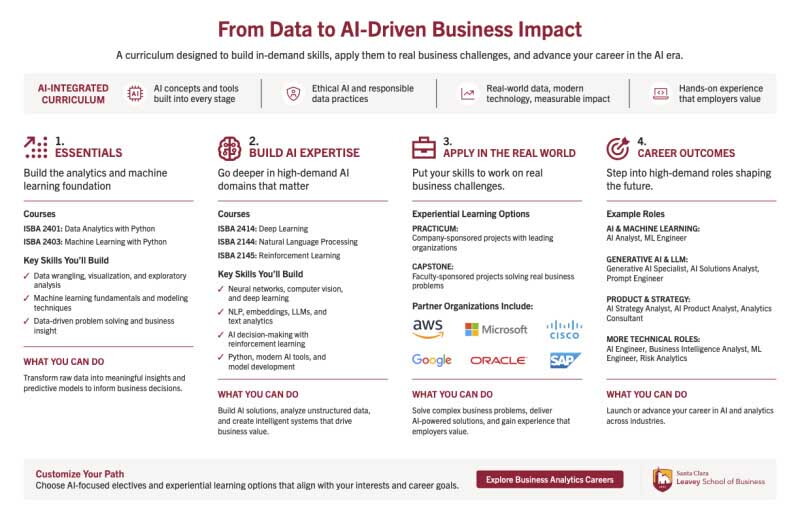
Meeting business analyst education requirements is crucial for entering and advancing in the field. A bachelor's degree is the typical starting point, but for senior and specialized roles, employers increasingly look for a master's.1 Coursework in mathematics, statistics, and computer science is highly valued, as analysts rely heavily on statistical and database software.4
Professionals often ask, "Is a master's in business analytics worth it?" In a market this competitive, the honest answer is yes, and the reason is simple. An advanced degree closes the gap between knowing the tools and leading with them. Advanced education helps professionals acquire the exact business analyst skills required for leadership roles, while building the kind of peer network that opens doors for years to come. Prospective students should carefully review admissions requirements to ensure they are prepared to take this vital next step in their careers.
Build the Career Data Was Made For
The business analyst's role is being rewritten in real time. The professionals who thrive in 2026 and beyond will be the ones who pair technical depth with sharp business judgment, ethical clarity, and the communication skills to influence the room. That's a tall order, and it's exactly what the right graduate program is built to develop.
Santa Clara University's Online Master of Science in Business Analytics (MSBA) program was designed for this moment. The curriculum delivers technical depth through coursework in SQL, Python, machine learning, R, and data visualization, all while emphasizing the business acumen, ethical leadership, and communication skills that distinguish working analysts from true analytics leaders. Faculty bring frontline experience from companies including Google, Cisco, Meta, Apple, and LinkedIn into every course, so what you learn on Tuesday can shape your work on Wednesday.
Because the program is fully online, you don't have to choose between your career and your education; you can advance both at once. In as few as 15 months, you can complete your degree, join an alumni network more than 100,000 strong, and step into the senior analytics roles where data fluency meets strategic influence. And because the program is rooted in Silicon Valley, the connections you build have a way of following you long after graduation.
Find out how the Online MSBA can help you become the kind of business analyst that leadership can't imagine working without. Contact us directly or schedule a call with an admissions outreach advisor to learn more.
- Retrieved on April 29, 2026, from bls.gov/ooh/business-and-financial/management-analysts.htm
- Retrieved on April 29, 2026, from indeed.com/hire/job-description/business-intelligence-analyst
- Retrieved on April 29, 2026, from iiba.org/knowledgehub/the-business-analysis-standard/4-implementing-business-analysis/4-4-understanding-requirements-and-designs/
- Retrieved on April 29, 2026, from bls.gov/ooh/math/operations-research-analysts.htm
- Retrieved on April 29, 2026, from weforum.org/publications/the-future-of-jobs-report-2025/digest/